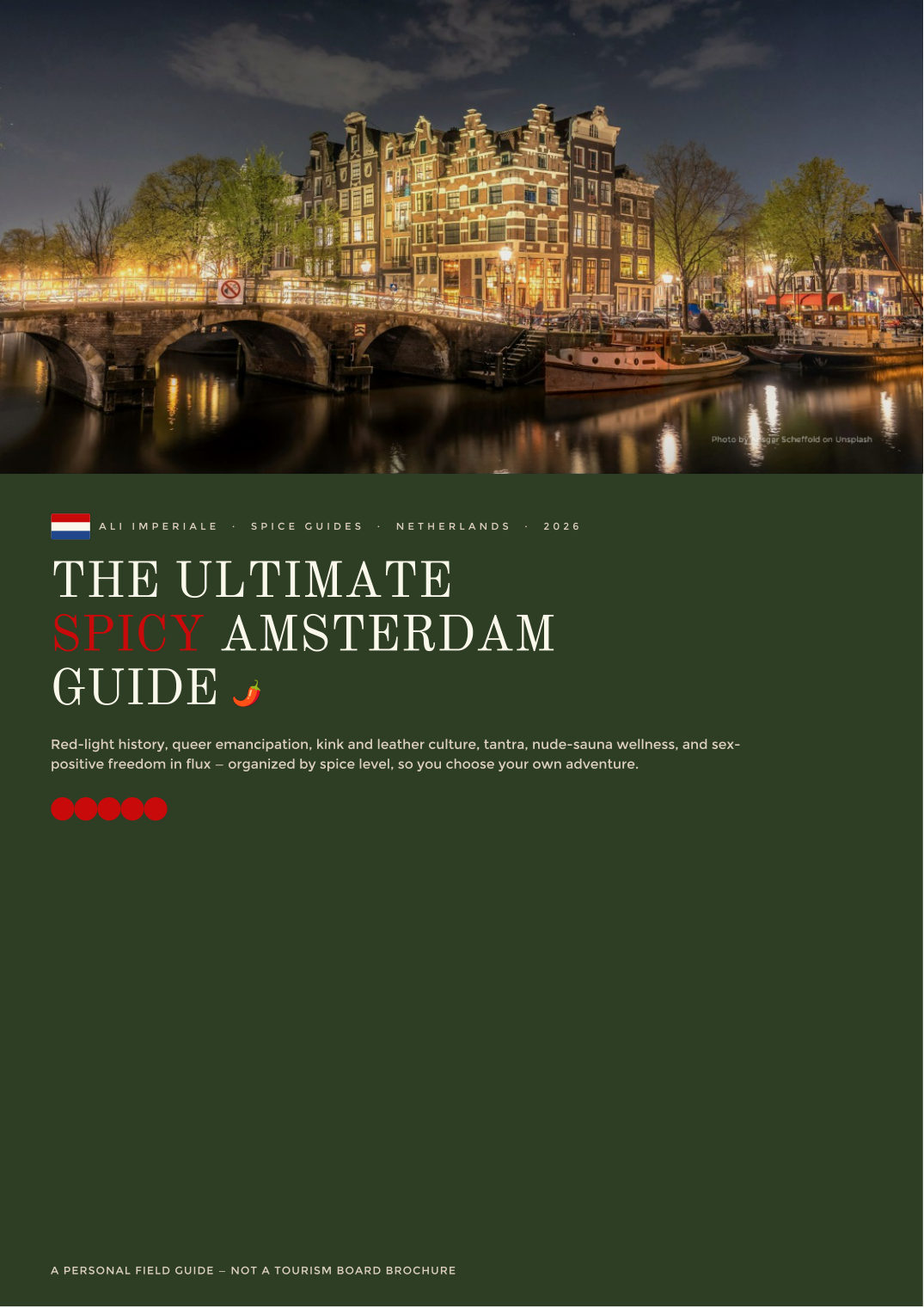
Editorial Disclosure: Independent editorial — Ali has visited Amsterdam multiple times over several years.
I've spent a fair amount of time in Amsterdam over the last few years — mostly because we have good friends who live there and it's an expensive city to visit without a free couch to crash on. And every time I go, I'm struck by the same thing: these people are just... relaxed about sex in a way that most of the world simply isn't.
Not loud about it. Not performative. Just relaxed. Like it's a normal part of being human. Which, of course, it is.
But it took me a while to understand why. And it took meeting someone from the Dutch Bible Belt — a part of the Netherlands almost nobody outside the country knows exists — to realize that the picture is more complicated than Amsterdam's famously open reputation suggests.
The Short Version of Why the Dutch Got Here
In the 1960s, the Netherlands was going through the same sexual revolution as the rest of the Western world. But where most countries pushed back against it — leaning on religion, tradition, and moral conservatism to slow things down — the Netherlands did something different.
They talked about it.
There's a Dutch concept called the Polder Model — a way of resolving conflicts through dialogue and consensus rather than conflict. The Dutch applied this same approach to sex. Instead of treating the sexual revolution as a threat to be contained, they treated it as a conversation to be had. Openly. Practically. Without hysteria.
That decision, made decades ago, shaped everything that followed.
The Sex Education That Actually Works
Dutch children start learning about sexuality at around age four.
Before you panic — it's not what you think. At four, they're learning about relationships, respect, and bodies. By the time they reach puberty, they already have a foundational understanding of what's happening to them and why.
The Netherlands consistently has some of the lowest rates of teen pregnancy and STI in Europe. A widely cited comparative study from Advocates for Youth on adolescent sexual health in Europe versus the United States found that Dutch teen pregnancy rates are dramatically lower than those of the US.
Not because Dutch teenagers are having less sex — they're not. Because they're better informed.
The lesson is frustratingly simple: when you treat sex as a normal part of health and education, people make better decisions about it. When you treat it as shameful and secret, they don't.
The Legal Framework — What Makes It Different
Prostitution in the Netherlands is legal and regulated. Sex workers have labor rights, access to healthcare, and legal protections. The industry is taxed and overseen.
The philosophy: if something is going to happen regardless of whether it's legal, why not create conditions that make it safer for everyone involved? Criminalization doesn't eliminate sex work. It just makes it more dangerous for the people doing it.
The red light district in Amsterdam is part of this framework. It's in a beautiful part of the city — canals, cobblestones, gorgeous architecture — and yes, it's very touristy. But it's also a place where workers have protections and rights that their counterparts in criminalized industries don't.
The Media, The Nudity, and the Body
Turn on Dutch television and you'll see open discussions about sex. Naked bodies in advertising and art. Frank portrayals of intimacy that would never make it past a network censor in North America.
But here's the thing: it's not sensationalized. It's just... there. Part of life. Part of culture. Nobody is making a big deal about it because there's nothing to make a big deal about.
The nude spas throughout the Netherlands are a perfect example. You go. You're naked. Everyone else is naked. After about ten minutes you forget you're naked. You see real bodies in all their variety and something shifts in how you think about your own.
The Part Nobody Talks About: The Dutch Bible Belt
Here is where the picture gets more complicated.
There is a region in the Netherlands — running roughly from Zeeland in the southwest through to the northeast — known as the Bible Belt. It is overwhelmingly Protestant, deeply conservative, and operates by a completely different set of values than the Amsterdam most of us picture when we think of the Netherlands.
In Bible Belt communities, men are the biblical head of the household. Women are expected to dress modestly. Dancing, loud music, and many forms of entertainment are discouraged. Sexual activity is reserved for heterosexual marriage. Homosexuality is not discussed.
I didn't know any of this until I met someone firsthand — a Dutch woman who had grown up in the Bible Belt, married at 19, and spent a decade in what she described as a deeply repressed environment. She had left, moved to Mexico, and was in the process of rebuilding a relationship with her own body and desire. Her story was one of the most striking reminders I've encountered that no country is monolithic.
The Netherlands that the world knows — progressive, open, sex positive — is largely Amsterdam and the major cities. Outside those centers, the picture is more nuanced and in some regions, entirely different.
What the Dutch Get Right — And What's Still Being Worked On
What they get right:
Starting sex education early. Treating bodies as neutral rather than shameful. Legalizing and regulating sex work. Creating a culture where sexuality is discussed as part of health rather than hidden as a source of shame.
What's still being worked on:
Sex education quality varies significantly by school and teacher. The Bible Belt remains deeply conservative. And even Amsterdam has been slowly walking back aspects of the red light district amid debates about tourism and exploitation.
Nowhere is perfect. But the Dutch approach is one of the most instructive models in the world — not because it solved everything, but because it started from a fundamentally different premise. Openness, not shame. Dialogue, not silence.
What I Take From All of This
Every time I'm in the Netherlands I come home slightly different. More relaxed in my own skin. More convinced that the shame most of us carry about sex is not inevitable — it's learned, and therefore it can be unlearned.
The Dutch didn't get here by accident. They got here by choosing, repeatedly and collectively, to treat sexuality as a normal human thing. To talk about it. To educate around it. To regulate it rather than pretend it doesn't exist.
We could choose that too.
💬 Is It Just Me?
Have you experienced Dutch culture firsthand — the openness, the nude spas, or perhaps the Bible Belt? How did it compare to where you grew up?
Submit anonymously → /is-it-just-me
The Details
📍 Amsterdam, Netherlands
🔗 Sexual Health Alliance: sexhealthalliance.com
🔗 Advocates for Youth research: advocatesforyouth.org
🔗 NIH Dutch national survey: ncbi.nlm.nih.gov/pmc/articles/PMC5857809/
Also in The World Issue:
About the Author
Ali Imperiale is a sex education student with the Sexual Health Alliance, a writer, and a traveler. She has visited 40+ countries and writes about sex, intimacy, and culture from wherever she currently is. The Nookie Nook is her shame-free, algorithm-free intimacy library.