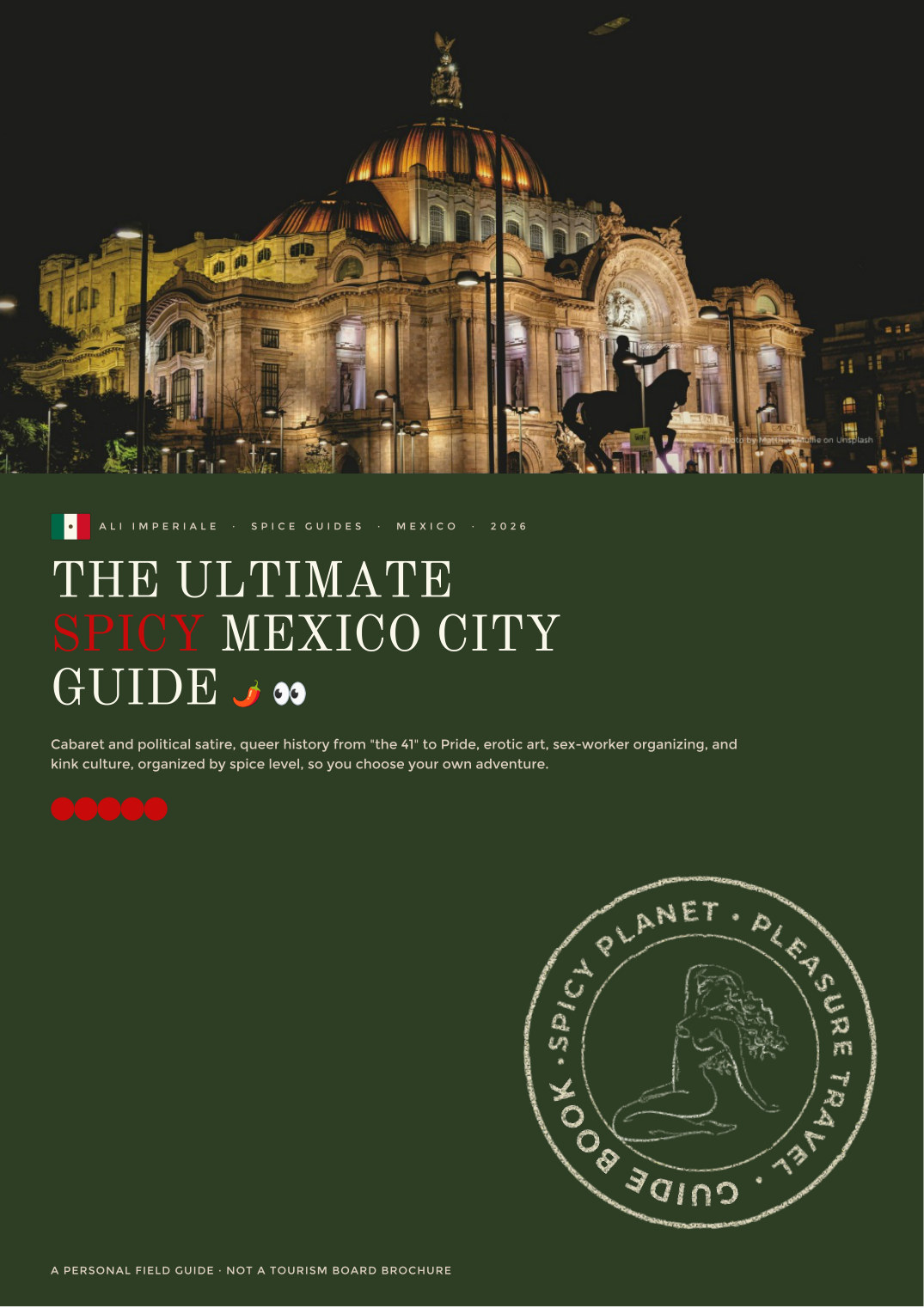
Editorial Disclosure: Independent editorial — Ali has been spending time in Mexico for four years. All observations are personal.
Legal public sex. Love hotels with St. Andrew's crosses. Retirement homes for elderly sex workers. A shelter funded by a former sex worker. Public displays of affection barely tolerated in rural towns while Mexico City has one of the most vibrant LGBTQ+ communities in Latin America.
Grab a margarita. Mexico's sex culture is one of the most fascinating and contradictory I've encountered anywhere.
I've been spending chunks of time in Mexico for the past four years — mostly in the jungle, sometimes in Cancun, Playa del Carmen, and Mexico City. I'm currently right here as I write this, surrounded by jungle sounds, thinking about how much of what I've learned about this country has surprised me.
Here's the version that doesn't make it into the travel brochures.
The Fundamental Divide
Mexico is enormous. It is home to one of the largest cities in the world and some of the most isolated rural communities in Latin America. And depending on which Mexico you're in, your experience of sexuality, dating, and intimacy will be almost unrecognizably different.
In urban areas like Mexico City, Guadalajara, Monterrey, and the major tourist corridors — attitudes toward sex are considerably more modern. Thriving LGBTQ+ communities, kink and fetish scenes, swinger communities, dating apps connecting people of every orientation and interest.
In rural areas, the picture is completely different. Conservative family values, strong Catholic influence, traditional gender roles, and very limited space for conversations about sex outside of marriage and reproduction.
Both are Mexico. Both are real. Neither cancels the other out.
The Dating Scene — What I've Actually Experienced
Mexico is probably the place where Gab and I have had the most fun dating and meeting people. We use apps when we travel and have met a genuinely interesting mix of foreigners and locals, mostly in Cancun, Playa del Carmen, and Mexico City.
One evening in Mexico City stands out. We met a woman who was kinky, confident, and wonderful. We went to Orinoco — known for their extraordinary chicharon de Monterrey, which I still think about regularly. On the second date she came over. I'll just say it was erotic, it was creative, and it involved the kitchen counter.
The point is: in urban Mexico, the dating scene has real energy. People are curious, adventurous, and incredibly warm about it. There's a generosity to Mexican sexuality in the cities that I find genuinely appealing.
Interesting Fact #1 — Public Sex Is (Sort Of) Legal in Guadalajara
Public sex is not exactly legal in Guadalajara. It remains an administrative offense under the city's bylaws.
What changed in 2018 is that police were instructed they could only intervene if a third party filed a formal complaint while the act was still underway. Before the reform, police routinely extorted couples caught in public sexual acts — even just kissing. A survey of university students found 90% had been victims of this kind of extortion.
Council member Guadalupe Morfín Otero proposed the reform to stop the shakedowns. The law change essentially tells police: don't act on your own initiative. If no one complains, it's not your business. The goal was anti-corruption, not the legalization of public sex per se.
That context makes it significantly more interesting than "Guadalajara legalized public sex."
Interesting Fact #2 — The Love Hotel Culture
The typical Mexican love hotel experience: you pull up to what looks like an ordinary building. You drive into an underground garage. A door comes down behind you. You've got complete privacy from the moment you arrive — nobody sees your car, nobody sees you come in.
The rooms vary wildly. Some are basic. Some have Jacuzzis, mood lighting, mirrored ceilings, themed decor. Some have furniture specifically engineered for various sexual positions. Some have St. Andrew's crosses for the more adventurously inclined.
And yes — many of them smell like cigarettes. That's just part of the love hotel character across all price points.
The underground garage and door mechanism are specifically designed so that clients from different rooms never see each other. In a culture where Catholic values and family reputation carry enormous weight, that anonymity is genuinely valuable.
Interesting Fact #3 — Puerto Vallarta Is Mexico's Gay Capital
Puerto Vallarta deserves its own mention as one of the most important LGBTQ+ destinations in all of Latin America — and specifically, the gay capital of Mexico.
Since the 1970s, Puerto Vallarta has been building what is now one of the world's most welcoming and developed gay tourism infrastructures. The Zona Romántica is now home to dozens of gay bars, clubs, hotels, and restaurants, with an energy that CNN has described as having "one of the best week-long Pride festivals in the world."
Three in every ten hotels in Puerto Vallarta are now LGBTQ+ friendly. The city estimates that one in five annual visitors comes from the LGBTQ+ community.
For gay men especially, it is one of the premier beach destinations in the world. Not just in Mexico — in the world.
Interesting Fact #4 — Sex Work Is Legal (Sort Of)
Prostitution is legal in Mexico but regulated differently depending on the municipality. Workers in regulated areas must register and carry a health card with regular testing.
Sex work is still heavily stigmatized, shaped by Catholicism and traditional gender roles. Female sex workers face harsh social judgment while their male clients generally do not.
Two organizations doing important work:
Amapola — founded by former sex worker Acadine Munoz, this is a shelter for elderly sex workers providing food, accommodation, and health services. Search online to donate.
Chas de Puebla — a civil association of over 60 sex workers in Puebla, led by Mariela Gonzalez, collaborating with local health services to ensure workers receive essential healthcare respectfully.
Interesting Fact #5 — Same-Sex Marriage Is Legal Nationwide
Mexico City was the first place in Latin America to legalize same-sex marriage in 2010. By 2022 the rest of the country followed.
Zona Rosa in Mexico City is a famous cultural and nightlife district considered the heart of the LGBTQ+ community in Mexico and one of the most vibrant in all of Latin America.
Interesting Fact #6 — Machismo and Its Consequences
Machismo shapes so much of what happens in Mexican relationships and sexuality.
At its core: bravery, honor, the provider role. But packaged with hypermasculinity, emotional suppression, dominance over women, and deep resistance to vulnerability.
For men: always expected to initiate, always perform, always know what to do — zero permission to be uncertain or ask for guidance.
For women: Marianismo — idealizing women as morally superior beings confined to traditional roles. This denies agency over their own sexuality.
The result: men who can't admit they don't know something in bed, women who can't take initiative or express desire, and a lot of couples quietly struggling with intimacy issues neither party has language to address.
Sex Education in Mexico — Still a Work in Progress
Sex education is inconsistent, frequently resisted by conservative groups, and still far too focused on risk rather than pleasure, communication, or consent.
The consequences are visible: high teen pregnancy rates in rural areas, limited access to sexual health resources outside major cities, and a generation piecing together their understanding of sex from the internet and each other.
Sound familiar? It should. It's the same story in most of the world.
What I Love About Mexico's Relationship With Pleasure
For all the contradictions and complications, there is something about Mexican culture's relationship with pleasure — food, music, dance, physical affection, the unapologetic enjoyment of life — that I find genuinely beautiful.
Mexico is still figuring a lot of this out. But it's doing it with more color and flavor than most places manage.
💬 Is It Just Me?
Have you experienced Mexican dating or sex culture — in the cities or in more rural areas? Did the contrast between conservative and progressive Mexico surprise you?
Submit anonymously → /is-it-just-me
The Details
📍 Mexico City · Cancun · Playa del Carmen · Guadalajara · Puerto Vallarta
🔗 Amapola — shelter for elderly sex workers: search online to donate
🔗 Chas de Puebla — sex worker civil association, Puebla
Also in The World Issue:
- Pleasure Travel — What It Is and Why More People Are Doing It
- Thailand Part 1 — The Most Sexually Confusing Country I've Ever Visited
About the Author
Ali Imperiale is a sex education student with the Sexual Health Alliance, a writer, and a traveler. She has visited 40+ countries and writes about sex, intimacy, and culture from wherever she currently is. The Nookie Nook is her shame-free, algorithm-free intimacy library.